Jiri to Everest Base Camp Trek – 19 Days
Trip Facts
Duration: 19 Days
Maximum Altitude: 5545m
Best Time: Autumn and Spring
Meals: Breakfast, Lunch, and Dinner
Accommodation: Hotel/Tea house/camp
Grade: Moderate
Activity: Trekking
Transportation: Flight/Private vehicle/Public vehicles
Jiri to Everest Base Camp Trek Highlights
- The magnificent views of 8,848.68 meters, the highest summit in the world,
- Enduring Sherpa’s culture, traditions, and friendliness.
- Observe the setting sunset over Mount Everest from Kalapatthar, commonly known as the Everest viewpoint,
- Explore Sagarmatha National Park’s wildness.
- Nepal’s vibrant Namche Bazaar is the only gateway to the Mount Everest region located in the Khumbu District,
- Arrive at Lukla’s high-altitude Hilary Tenzing Airport, a unique experience,
- The peaceful atmosphere within the majestic Tengboche Monastery,
- Explore the world-famous, gigantic Khumbu Glacier and Khumbu Icefall,
- Trek through highly dense forests, especially those with rhododendron plants, to witness various wildlife.
Trip Information:
The Jiri to Everest Base Camp Trek is one of the most challenging and rewarding treks in Nepal. Since Edmund Hillary and Tenzin Norgay Sherpa successfully conquered Mt. Everest in 1953, adventurers from around the globe have been drawn to Nepal, eager to experience the allure of the world’s highest peak.
Everest’s frightening pinnacle ascends so high that the trekking to the base camp is as yet an experience of the most elevated classification. The tremendous view of this Everest district with green thick woods, vegetation, high awesome ice sheets, and unmistakable one-of-a-kind settlement of Sherpa individuals with their way of life and customs are the most lovely thing that you can see here.
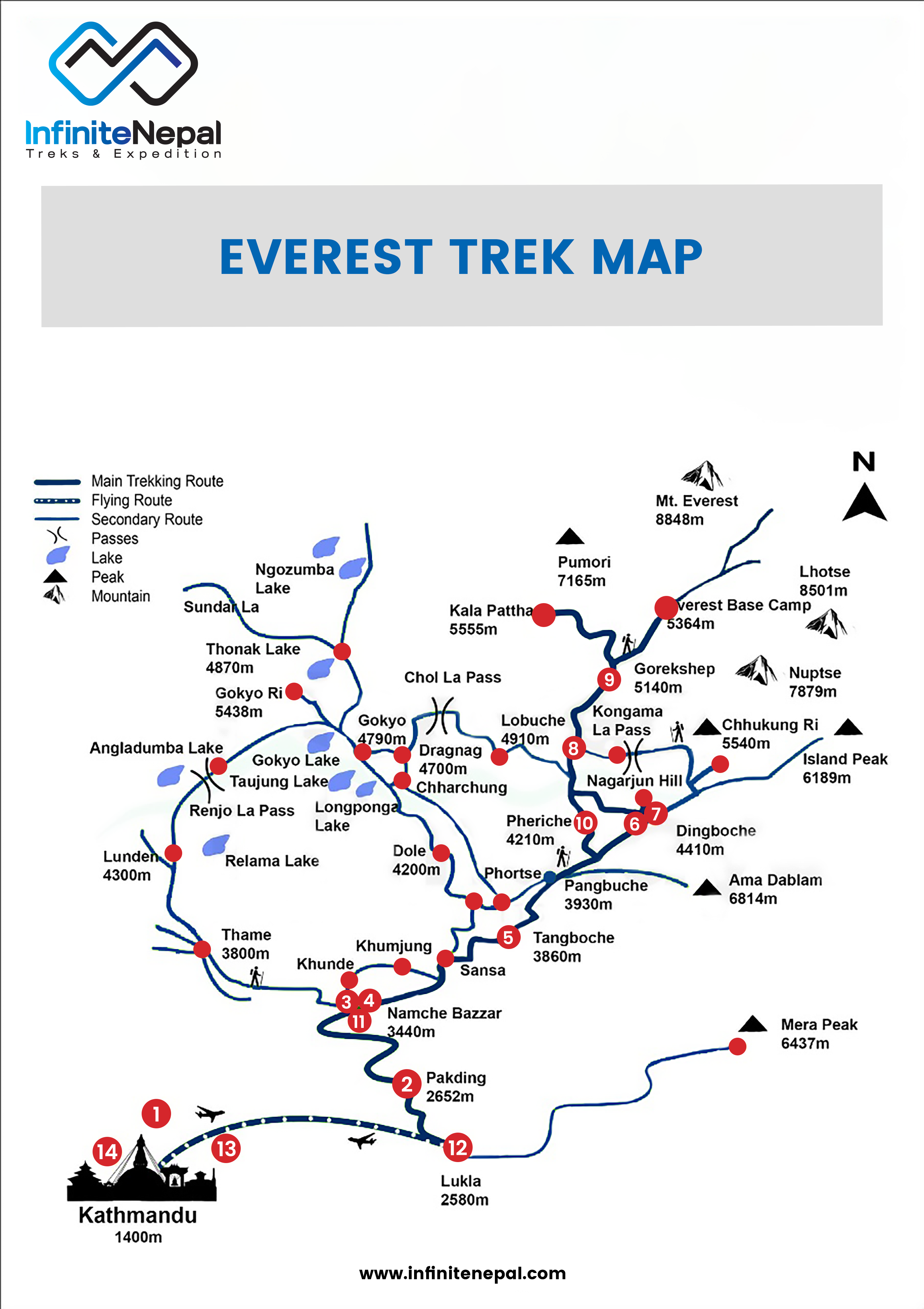
Fundamentally, there are two courses at Everest Base Camp i.e., Jiri and Lukla. Individuals favor the two courses. Furthermore, our Jiri to Everest base camp trek has been made with conference with experienced and proficient trekkers keeping in mind the end goal to give you security and appropriate acclimatization. Amid the trek, we go through the high timberlands, cold streams and will appreciate the warm cordiality of various ethnic individuals dwelling here. We will get a chance to visit the Buddhist religious communities with supplication hails, the Sherpa individuals, and other ethnic towns with their basic however rich mountain ways of life. The perspectives that you can see from here are ravishing. Also, strolling in the Himalayas is a significant exceptional ordeal. Jiri is home to the exemplary Everest trail. Numerous trekkers favor investigating the wild and peacefulness of the area here. Everest Base Camp through Jiri additionally features the social lavishness of Kathmandu Valley.
Infinite Nepal exceedingly prescribes Jiri to Everest Base Camp Trek for the individuals who are anticipating encountering the exceptional and extraordinary scene of Eastern Nepal and watch and associate with ethnic tribes and investigating assortments of widely varied vegetation. Go along with us to encounter to a great degree distinctive experiences with our group. We put our entire push to make your excursion unparalleled. Pick up the pace and allow us to serve you.
Itinerary
Max. Elevation: Kathmandu (1,300m)
Meals: Dinner
Our agent will welcome you upon arrival at Kathmandu's Tribhuvan International Airport and arrange a transfer to your lodgings. The official will present you with a list of everything you might need for your trip, as well as a brief account of your hike on the Everest Circuit. Stay overnight in a hotel.
Meals: Breakfast, Lunch, Dinner
Exploring the historical sites listed as UNESCO World Heritage Sites is part of the visiting experience in the Kathmandu Valley. The main attractions of this journey are the marvels of the renowned Hindu temple of Pashupatinath, the Buddhist pilgrimages of Boudhanath Stupa (the largest Buddhist stupa in the world), and Swayambhunath Stupa or Monkey Temple. You then go to Durbar Squares in Patan and Kathmandu in the afternoon. You'll be going back to the hotel in the evening.
Before leaving for the mountains, Kathmandu is an ideal spot to make any last-minute purchases of trekking gear or refreshments. Thamel is the best location for purchasing trekking equipment. Our official will provide detailed information about the trek.
Max Elevation: Salleri (2390m)
Meals: Breakfast, Lunch, Dinner
Distance Travelled: 267 km
Drive Duration: 8-9 hours
It's time to kick off your journey! Depart for the 267km bus journey across the Himalayan foothills after having your breakfast early in the morning. You can go either a private Jeep or a local bus via the BP Koirala Highway to the Khurkot and Khurkot Ghurmi Madhya Pahadi Highway, which offers stunning views of the mountains and surrounding countryside.
You pass the bridge at Sun Koshi and travel through the Okhaldhunga district before arriving in Salleri. Salleri is located in the Sholukhumbu district and is quite large, with numerous government buildings, campuses, and hospitals. You will stay overnight at the hotel at Salleri.
Max Elevation: Nunthala (2,220m)
Meals: Breakfast, Lunch, Dinner
Trek Duration: 6-7 hours
Today, after breakfast, you leave the resort and begin your walk. You walk down a wide country road. Nearly every village has a monastery, and every home has brightly colored Buddhist prayer flags flying from it.
The majority of individuals in this place practice Mahayana Buddhism. The trail descends gradually to the Nunthala (Mani Dingma) at 2,220 meters after passing through the Sherpa and Rai settlement, rice traces, and alpine forest.
You walk over small streams and hilly gorges today, making it comparatively the easiest and most comfortable day of the journey. Walking on the trail offers a wonderful view of the Numbur Himal. You will first get a glimpse of Mount Everest as you walk through a tropical forest. You will be able to see not just Mount Everest but also the other mountains in the Khumbu region.
Max elevation: Bupsa (2,360m)
Meals: Breakfast, Lunch, Dinner
Trek Duration: 5-6hrs
After breakfast in the early hours of the morning, the walk continues. To get to Kharikhola, the trail passes through forests and the Dudhkoshi River, following the Dudh Koshi River up to Jubing Village, the trail declines.
The route goes on through trees till it reaches Jubing's Rai village. Kharikhola is only 2 hours far away after arriving at Jubing village. After passing through the village of Khari Khola and along a ridge, you arrive in Bupsa (2,300m). You visit the monastery at the top of the hill in the evening.
Max elevation: Chaurikharka (2,650m)
Meals: Breakfast, Lunch, Dinner
Trek Duration: 4-5 hrs
Early in the morning, you ascend towards Chaurikharka. You climb up to Chaurikharka, a large Sherpa village. You will pass villages like Sukre and other Sherpa villages till you reach Chaurikharka.
The trail now leads north to Chaurikharka, a monastery and high school, which is a large distributed village with fertile soil. The Khumbu region's Chaurikharka (2,650m) is often referred to as the breadbasket because it produces an adequate amount of wheat, barley, and green vegetables.
Max elevation: Monjo (2,840m)
Meals: Breakfast, Lunch, Dinner
Trek Duration: 4 - 5 hours
The trail crosses the Dudh Koshi River five times today, generally along its bank. Following the suspension bridge, the path ascends towards Chhamuwa, a small Sherpa town housing an agricultural project farm. To get to Monjo village, you drive past a small hydroelectric plant and groups of farmhouses.
You are going to enter Sagarmatha National Park in Manjo, where your permits will be examined.
Max elevation: Namche Bazaar (3,440m)
Meals: Breakfast, Lunch, Dinner
Trek Duration: 3 - 4 hours
Early in the morning, after having breakfast, you will be heading towards the business hub, Namche Bazaar. Now, for the first time on the trek, you can see Nupste (7,879m) and the summit of the world, Mt. Everest (8,848m), as you ascend your way up through the jungle for 45 minutes.
You rise towards the Dudh Koshi Valley by following the level trail along the riverbank.
After walking for 5 to 6 hours through the national park forest, the trail finally ends at Namche Bazaar, an ancient hub for trade. In this area, this is the largest town. You can go shopping and enjoy a luxurious lifestyle. You will spend the night in Namche Bazaar relaxing in the peace of nature.
Max elevation: Khumjung (3,780m)
Meals: Breakfast, Lunch, Dinner
A crucial aspect of trekking is rest and acclimatization. This is a rest day at Namche Bazaar for acclimatization before heading to Everest Base Camp. You will have a walk to the National Park Headquarters, where you can visit a museum and enjoy an amazing view of many majestic mountains, including Mount Everest.
After that, you'll walk down to Khumjung and Khunde, the twin villages. ATMs, Internet cafés, bakeries, and other services are all properly provided. Incidentally, suppose you happen to be in Namche Bazaar on a Saturday. In that case, it's worth stopping by the weekly Saturday markets located on the southern edges of the town, where a variety of goods are offered.
You can take a walk to the Namche Bazaar in the evening. The Sherpa Cultural Centre, a gallery showcasing Sherpa heritage, is another place you can visit.
Max elevation: Tengboche (3,870m)
Meals: Breakfast, Lunch, Dinner
Distance Traveled:10km
Trek Duration: 5 - 6 hours
After a rest day in Namche, you hike all the way to Tengboche. The trail climbs the hill's ridge above the town and the neighboring museum. After that, enjoy an enjoyable walk in the forest over the Dudh Koshi River, which offers stunning views of the mountains, and you will reach the Kenjoma.
Along the entire path, mountain goats frequently graze. These pathways are surrounded by rhododendron forests, which are fragrant and beautiful. After 45 minutes of descending the riverbank, you arrive in Phunki Tenga.
Tengboche is around 6 hours away from Namche Bazar. Ascending the trekking trail, you travel through Chhorkung, Kyangjuma, and Sanasa before arriving at Tengboche. You'll ascend past some prayer wheels that run on water on your pathways.
Tengboche Gompa's major feature is a 20-foot sculpture of the Buddha, which you can explore. In the evening, offer your prayers at the monastery. You spend the night in Tengboche at a resort.
Max elevation: Dingboche (4,360m)
Meals: Breakfast, Lunch, Dinner
Distance traveled: 9km,
Trek Duration: 5 - 6 hours
After breakfast, the trail descends from Tengboche through a gorgeous mossy forest of pines and rhododendrons to Dboche (3,820m). The trek goes on to the small community of Milinga through the forest located above the Imza River.
The trail now follows the greater Imza Valley, where farms and tea houses can be seen to Dingboche (4,360m). Dingboche is known as Summer Valley. Dingboche is a relatively large village with few teahouses and lodges.
Beautiful fields with stone walls separating them from the cold and animals are what greet us as soon as you arrive in Dingboche. These fields are home to crops like barley, potatoes, and buckwheat. You're going to stay here for tonight.
Max elevation: Dingboche (4,360m)
Meals: Breakfast, Lunch, Dinner
One more day to get used to the new environment. You must acclimatize as you continue to travel at high altitudes to protect your health and well-being. Today, get used to the high altitude and get ready for the exciting trek to Everest Base Camp.
Altitude sickness cannot be avoided by the human body unless it adjusts to the rising altitude and changing surroundings so take a break day to acclimatize yourself. You will have the oppurtunity to enjoy the beauty of Dingboche valley and the surrounding area.
Additionally you can hike to Nangkartshang Peak, which is 5083 meters above Dingboche, After early morning breakfast( or you can have breakfast after returning from the Hike) . You will be treated to amazing views of high peaks including Mt. Ama Dablam, Taboche, Cholatse, Lobuche peaak, Nuptse, Thamserku, Island peak, Mt. Makalu, Barunste, Peak 38 and many more.
The trail to Nangkartshang peak is quite challenging, requiring a climb of about 677 meter from the Dingboche (4410m). The path is steep and will take around 3-4 hours for the round trip. Make sure to bring plenty of water(1.5 to 2 liter) and some snacks, such as Snickers bars and dried foods. Dont forget to apply sunscreen and wear a buff to protect your face and neck as the route to peak can be very windy. Its also good idea to wear a warm down jacket and use trekking poles if needed.
Max elevation: Lobuche (4,940m)
Meals: Breakfast, Lunch, Dinner
Distance traveled: 7km,
Trek Duration: 5-6 hours
After breakfast, we set off for a trip to the Lobuche. The path rises sharply to the hilltop crest above the Dingboche. The trail starts with a moderate walk up to Thukla (4600m), where you can take a tea break or even lunch because there is nothing to explore between Thukla and Lobuche.
After that, there will be a hard climb to Thukla Pass (4800m). Here, you can witness various memorials of Everest summiteers who lost their lives during the Everest expedition.
It will only take a few more hours of climbing to get to Lobuche for dinner. A few lodges and tea houses with views of Mount Nuptse and Lobuche are available in Lobuche. From the village, you can enjoy a panoramic view of Nuptse, Lobuche, and Pumori's mountains. Enjoy the sunset at Nuptse Peak in the evening.
Max elevation: Everest Base Camp (5,364 m)
Meals: Breakfast, Lunch, Dinner
Distance traveled: 13km,
Trek Duration: 6-7 hours
This will be the hardest and most rewarding day of the trek. Today's trek consists of two parts today. The trail first travels to Gorak Shep before arriving at Mount Everest Base Camp. You leave Lobuche after having breakfast, climbing alongside the Khumbu glacier, and enjoying the breathtaking views of Mt. Nuptse.
After more than 1 hour of trekking along the rocky steps, you reach Gorak Shep Village. After resting for a while, you will head to Everest Base Camp With plenty of drinking water, warm clothes, energy bars, hiking poles, and a headlamp, leaving a heavy backpack in Gorak Shep because you will be descending to Gorak Shep after enjoying the majestic view of Everest Base Camp.
Explore the base camp and take pictures to remember the moment. Together with your mentors and teammates, enjoy the moments. Being at the foot of the highest mountain in the world is an amazing feeling. You will return to Gorakshep for an overnight stay.
Max elevation: Kala Patthar (5,545m)
Meals: Breakfast, Lunch, Dinner
Distance traveled: 16km,
Trek Duration: 7-8 hours
Today, You walk to Kalapatthar, one of the most beloved landscapes. Enjoy the beauty of the majestic sun shining its beams upon the Himalayan Mountains. The view of Mount Everest from Kala Patthar is breathtaking and truly amazing. You capture pictures of this beautiful place.
Descending towards Gorakshep is the next step, but for today, Your ultimate destination Pheriche. There's a small settlement in Pheriche. This little village is located at the base of Tabuche, across from Dingboche. You will spend the night at the Lodge.
Max elevation: Namche Bazaar (3,440m)
Meals: Breakfast, Lunch, Dinner
Distance traveled: 20km,
Trek duration: 6 - 7 hours
After having breakfast, you begin the trek towards Namche Bazar. From Pheriche, You descend to a lower elevation today. After arriving at Debuche, You climb for an hour to reach Tengboche. You might visit the monastery for a while before having lunch by the river in Phunki.
You will climb for around two and a half hours after lunch and relaxation, passing through little settlements to reach the other side of the valley. You will proceed to the side of a mountain to come to the Namche Bazaar.
When you reach Namche, finish your day with a hot shower. Visit various local cafes to savor the baked cookies or your favorite coffee.
Max elevation: Lukla (2,860m)
Meals: Breakfast, Lunch, Dinner
Distance traveled: 19km
Trek duration: 6 - 7 hours
The walk descends through the jungle to the bridge where the Dudh Koshi and Bhote Koshi rivers meet. Next, You proceed to the Jorsale, Manjo, Benkar, Tok Tok, Phakding, and Ghat Sherpa villages via the riverbank.
You will walk down to Lukla, retracing our route, which will take us about 7 hours. You will have to book a flight ticket to Kathmandu earlier as soon as you reach Lukla. Since today is the last day of the trek, you will spend the evening with the porters and other members of the support staff.
Flight Duration: 30-46 mins
Meals: Breakfast, Lunch, Dinner
Early in the morning, a flight operated from Lukla to Kathmandu. You will be able to see amazing views of mountains, rivers, forests, and much more on your trip back to Kathmandu. It takes roughly 35 minutes to 40 minutes to reach Kathmandu from Lukla.
Due to bad weather and other unexpected events, flights may occasionally be canceled or delayed by one hour. Thus, we would like to suggest that you schedule a flight for one more day to return to Kathmandu. You will be surprised yet again by Kathmandu after spending so many days in the Himalayas.
After breakfast today, we will say goodbye as your 19-day Jiri to Everest Base Camp trek concludes. We will drop you off at Tribhuvan International Airport for your flight home. We hope you enjoyed the thrilling journey through the Khumbu region and made unforgettable memories. Thank you for trekking with us! Have a safe flight back home.
Whats Included
- Airport picks up and drops by private vehicle.
- Domestic flights (Kathmandu- Lukla -Kathmandu).
- Airport taxes.
- Guided city tour in Kathmandu by private car.
- Meals during the trek (Breakfast Lunch & Dinner) and Tea or Coffee.
- Guest House (Lodge) during the trek.
- 2 nights in Kathmandu and provide breakfast.
- License holder Guide.
- Porter service during the trek (one porter for two Guest).
- All Government and Local Taxes.
- All necessary paperwork and trekking permits including National Park Permit and TIMS.
- Guide and porter salary.
- Guide & Porter insurance during the trekking.
- Farewell dinner with Typical Nepali culture.
Whats Excluded
- Nepalese visa fee.
- Lunch & dinner at Kathmandu.
- Trekking gear.
- International flights.
- Travel and rescue insurance.
- personal expenses such as all Bar Bills Alcoholic or non Alcoholic Beverage drinks, phone and Laundry.
- Hot Shower.
- Tips for guide and porters.
FAQ
The trek to EBC is a challenging and strenuous adventure. The trek itself is on the moderate end of the trekking spectrum. However, a trekker has to be in good physical shape. Before organizing this EBC Trip, it is suggested to do some training to cope with high altitude illness.
Without a guide, you can trek to Everest Base Camp. But when things get tough or unexpected things happen, a guide is there to help you go on and make other plans and arrangements.
The ideal seasons to trek to Everest Base Camp are said to be in the spring and autumn. These seasons lack both the summer's monsoonal rains and winter's enormous snow dumps.
Everest Base Camp is at an altitude of 5,364 m or 17,598 ft above sea level.
Naturally, of course! Getting travel insurance is strongly advised, and be sure that it includes emergency evacuation at high altitudes.
You should elevate or decrease your altitude gradually. This will allow your body to adjust to reduced oxygen levels. Drink as much water as you can, abstain from alcohol, and eat meals to the fullest every time. Avoid flying straight into an area that is high above the ground.
Both regional cuisine and continental/Chinese cuisine are available. The meal may not taste exactly the same as it does at your place because it is prepared by the crucial local trainers.
Currently, all of the lodges that are managed by Sherpa natives have a lot of lovely, comfortable, and well-furnished rooms with pot belly stoves for heating. They also provide delicious meals and extend their hospitality to guests.
The Everest region, starting from Lukla, is located inside Sagarmatha National Park, the highest park in the world and a World Heritage Site since 1979.
The trip from Jiri goes to various downhill and uphill walks through several mid-hill villages where you can witness the local culture, walk through a lovely wooded region of rhododendrons, pines, and fir trees with spectacular views of high snow-topped mountains of Gaurishanker, Melung tse.
Useful Info
Jiri to Everest Base Camp Trek Permits
Thousands of trekkers, naturalists, and explorers visit this area yearly to take in the amazing topography. The Sagarmatha region’s protected zone contains Everest Base Camp. Therefore, entry permission is required for any journey into the Everest zone. Additionally, those Trek Card permits from Khumbu Pasang Lhamu Rural Municipality, Sagarmatha National Park, and the Gauri Shankar Conservation Area (Optional) are included in the Everest Base Camp Trek Permits. Trekkers will be able to reach their objectives without encountering any legal issues or questions if they obtain these permits.
These permits are available from several sources. Various resources do not imply that you may buy them at random from any merchant; you need authorization. Usually, the tourist center offices in Namche Bazaar, Monjo, and Lukla are where you may obtain this.
Sagarmatha National Park Entry Permit
The base camp is situated within the boundaries of Sagarmatha National Park, an area under strong protection designed to preserve rare plant and animal species. The Sagarmatha National Park Entry Permit will be useful after you arrive in Lukla and go to Phakding and other places. Additionally, a clause states that the Department of the National Park and Wildlife Conservation Center, Bhrikutimandap Kathmandu, is where you may obtain these permits.
Sagarmatha National Park entrance fees for foreign nationals are NPR 3,000 per person. However, the price is NPR 1,500 for SAARC citizens and NPR 100 for Nepalis. Youngsters under ten are admitted free of charge. To obtain this authorization, you must present your passport.
Khumbu Pasang Lhamu Rural Municipality Entrance Permit
The Khumbu Pasang Lhamu Rural Municipality Entrance permission is a recently established permission that is granted by the local administration in the Khumbu area. It came into use on October 1, 2018, and it took the place of the TIMS Card. The local administration will thus be in charge of collecting the Khumbu Pasang Lhamu Municipality permission costs.
This permission is exclusive to the Pasang Lhamu Rural Municipality in Khumbu, unlike SNP permits. With an expense of Rs. 2000, it is the same for all countries. The permit is available from the Tourism Board in Kathmandu too.
Gaurishankar Conservation Area Permit (For trek through Jiri)
The optional permission needed to start the Jiri to Everest Base Camp Trek is the Gaurishankar Conservation Area Permit. A few trekkers choose to go all the way from Jiri to Everest Base Camp. Since hikers must pass via the Gaurishankar Conservation Region, another restricted and protected region, a permit is required in this instance.
An individual’s Gaurishankar Conservation Area permit costs around 3,000 rupees. Once the necessary paperwork and references have been submitted, you may obtain them at the Nepal Tourism Board located in Kathmandu.
Food during Jiri to Everest Base Camp Trek
Food is important for any trip, but it is especially crucial for high-altitude adventures like the Jiri to Everest Base Camp Trek. The success and overall pleasure of the Everest Trek are greatly influenced by food. Maintaining a well-balanced diet becomes essential for trekkers to sustain their bodies and meet the physical demands of the demanding terrain and stunning scenery of the Himalayas. There are teahouses along the Everest Base Camp (EBC) climb. Most teahouses have a pretty similar menu.
Here are a few things you need to know about food during your trek to Everest. Three daily selections are included on the tea house menus, divided into categories for breakfast, lunch, and supper.
Breakfast options: Before embarking on a walk, it’s important to give your body a substantial breakfast to provide you with the energy you’ll need for the day. A substantial breakfast will keep you energized, increase your endurance, and provide you with nutrition throughout the trip. Popular breakfast spots along the EBC path include the following:
Porridge: Grains like oats, quinoa, barley, farro, or wild rice are boiled in liquids like water, milk, or dairy substitutes to make porridge. It is simple to make, offers long-lasting energy, and has a high fiber content, which facilitates digestion.
Tibetan Bread: Flatbread, cooked in oil, is pleasant, satisfying, and sometimes quite greasy. Carbohydrates, which are necessary for sustaining energy levels throughout lengthy hikes, are also abundant in bread.
Pancakes: Pancakes, which may be a delightful and energy-boosting breakfast. For added taste, you can drizzle honey, maple syrup, or fruits on top.
Eggs: One of the few foods that truly qualifies as a “superfood” is eggs. They can be cooked as an omelet, scrambled, or boiled. They offer sustained energy and aid in muscle recovery following a strenuous day of hiking.
Nepali Bread: A traditional sweet bread from Nepal, sel roti is made with rice flour, yogurt, and sugar.
Lunch and Dinner options: Here are a few well-known lunch and supper options:
Dal Bhat: This traditional Nepalese meal consists of steamed rice (Bhat) and lentil soup (dal). It is frequently served with a variety of pickles, papadums, and veggies. This nutritious lunch is perfect for trekkers since it offers an excellent combination of minerals, protein, and carbs. It is hearty and filling.
Thukpa: A noodle soup with mixed veggies and occasionally meat is called thukpa. Trekkers who are looking for warmth and food love Thukpa.
Pasta and macaroni: To accommodate the tastes of foreign hikers, EBC tea shops frequently provide pasta and macaroni meals. For individuals who enjoy well-known Western meals, these are straightforward and satisfying selections.
Momos: Momos are a type of steamed-filled dumplings. Momos are tasty and a convenient way to get energy when hiking.
Sherpa Stew: A filling and healthy dish made especially for hikers is sherpa stew. Meat, vegetables, and other local items are included in the meal; these are essential for the trip.
Pizza: On the EBC trip, several tea shops provide pizza, which may be a pleasant treat even though the components are simple.
Accommodation during EBC Trek: You will need a place to relax and spend the night wherever you choose to walk. Knowing all there is to know about the lodging options before setting out on the Everest Base Camp trip is crucial. Your EBC Trek’s comfort level might be significantly impacted by getting a decent night’s sleep. Every trekker worries about the kind of lodging they will have when traveling to Everest Base Camp.
There are relatively cozy and well-maintained tea shops along the EBC path. Since it is more difficult to find better accommodations during the peak season (March–June and September–December) due to the high volume of visitors, you should book your accommodation as soon as possible to ensure a comfortable stay during this time.
Tea Houses Accommodation: It’s common knowledge that the greatest accommodations for trekkers heading to Everest Base Camp (EBC) are tea houses. Basic varieties of tea establishments are available, assisted by affluent locals who know the area well. Tea houses are lodges created specifically to offer the bare necessities for hikers to relax. There are huge differences in housing quality.
Some tea houses at lower altitudes have fully furnished rooms with power, wifi, a Western-style toilet, and—best of all—a hot shower. Conversely, several tea rooms, particularly those situated at higher elevations, provide quite modest services.
While all teahouses at Everest Base Camp include electric or solar heaters, some on less-traveled trails only provide buckets of hot water. Another excellent spot to meet people searching for adventure trips in this area is the teahouse.
Camping Accommodation: An additional option for the EBC Trek is camping. The trekking crew often uses it when ascending Mount Everest. A tent is often used for lodging, including relaxing and sleeping. The culinary team will prepare meals, and several crew members are employed for certain tasks. The Everest Base Camp path offers a fantastic camping experience. However, most people avoid camping because tea establishments are easily accessible.
Accommodation in the Trail:
Kathmandu: The starting point of your travel to Nepal is the city of Kathmandu. There are several options for lodging, ranging from affordable motels to luxurious five-star establishments. These lodging establishments provide a diverse array of cuisines at varying pricing points. They provide a variety of dishes from across the world and the West.
Lukla: Trekking in the Everest area begins in Lukla. The majority of the time, planes from Kathmandu to Lukla arrive early in the morning due to weather conditions. Therefore, not many people spend their first night in Lukla. Most hikers would rather make their first stop in Namche or Phakding. There are several, and the lodging is typically superior to those found at higher elevations.
Namche Bazar: Good meals and opulent lodging are also available at different pricing points. Additionally, there are cafés and bakeries in this location. It’s possible to have a good time at Namche Bazaar.
Gorak Shep: As there aren’t many hotels, Gorak Shep is the most populated area. It might be hard to locate accommodations during the busiest times of the year, and you’ll have to deal with sharing rooms. Before reaching Everest Base Camp, this hotel is the last one (EBC).
Lobuche: Lobuche is mostly a hotel village. This area is home to a few upscale hotels. Apart from this, lodging is quite basic and might be scarce at the busiest times of the year. To the southwest of Lobuche is a camping spot for campers.
Pheriche: Trekkers stay the night here on their way back from EBC. The northern region of Dingboche is home to Pheriche. This area has a few simple teahouses.
Jiri to Everest Base Camp Trek Difficulties
It’s been said that challenging paths frequently lead to breathtaking places, and this travel is no exception. The trip helps the traveler arrive at a peaceful state of mind, but there are several challenges along the way. It may seem terrifying to consider strolling down the high-altitude path that leads to the base of the tallest peak on Earth. However, the difficulty of the Everest base camp trip is not as great as most tourists would have thought.
Treks to Everest Base Camp are demanding and need both physical and mental determination, but the benefits are well worth the effort. Recall that your physical challenges have given you greater resolve and ambition. The high altitude is one factor that makes the climb to Everest Base Camp challenging! You won’t comprehend the impact of altitude on your body until you’re trekking at an elevation of 4,000 meters above sea level. Your lightweight backpack doesn’t seem so light, the nearby rest area doesn’t feel so close, and the gentle elevation doesn’t feel like it is.
Treks to the Everest Base Camp are not easy excursions that you should do carelessly. The Everest Base Camp journey necessitates careful preparation, tenacity, and a fair level of physical condition.
For EBC, the trek starts at Lukla. You will follow the same route as Sir Edmund Hillary and others. Classic EBC trips from Lukla cover around 65 kilometers in one direction. Thus, you will have to go 130 kilometers. But keep in mind that you will need to travel this distance in twelve days on average, which equates to around eleven kilometers every day.
Additionally, remember that you will be hiking in isolated areas, sometimes on rough trails with sharp ups and downs. There are also plenty of wooded sections throughout the route. You have to keep in mind that the vistas are much more breathtaking from higher elevations.
Suspension bridges may provide challenges if you have a fear of heights. The routes leading to Everest Base Camp swiftly gain elevation, traversing many climate zones. There are several ascents and descents along the route, sometimes by enormous cliffs, and exciting suspension bridges are interspersed throughout. The Jiri to Everest Base Camp Trek is a “little challenging,” given these considerations. The Mount Everest Base Camp journey is rated as having a level three difficulty rating; it’s not the hardest trek in Nepal, but it is nonetheless demanding.
Physical Requirement for the Jiri to EBC Trek
For the Jiri to Everest Base Camp Trek with Infinite Nepal, a moderate degree of fitness is ideal. The altitude and difficulty characteristics of this magnificent trip are challenging because of its location near Mt. Everest (8,849 meters), the highest peak in the world. You could be motivated to participate in this journey by your desire to experience the Himalayas’ majesty up close, but if you are not physically fit, you might have to end it early.
People of all ages with good endurance, fitness, and agility may complete the trip to the base. The ups and downs will be easier to handle if you strengthen your legs. Include movements such as lunges, step-ups, and squats. The routes put your stamina and limits to the test, particularly the ones from Monjo to Namche Bazaar and Pugi Thanga to Tengboche. In the same vein, the arduous trek to Kalapatthar. While it’s not necessary to be athletic to participate in Base Camp Trek, a basic degree of fitness is needed. The EBC trek has some really difficult sections, so go slowly and take your time.
Best Time for Jiri to Everest Base Camp Trek
An exciting and secure Everest Base Camp Trek depends on choosing the perfect launch time. Let’s look at the best times to travel, taking into account the benefits and drawbacks of each.
Spring (March to May): The ideal season to trek to Everest Base Camp is said to be in the spring. This season lacks both the summer’s monsoonal rains and winter’s enormous snow dumps. In addition to the pleasant weather, the trail’s bright rhododendrons and enticing views of the beautiful sky are highlights. During this time, the harsh winter conditions begin to diminish as the weather begins to warm. A broad view of high peaks, including Mt. Everest (8848 m), Mt. Cho oyu (8201 m), Mt. Makalu (8481 m), Mt. Ama Dablam (6812 m), and others, may be seen in the spring.
Summer/Monsoon (June to August): The monsoon season in Nepal lasts from June to August. Also termed the rainy season of the year. Due to the mud, leeches, illnesses, and avalanche threats brought on by the rain, hikers are discouraged from going, making it the least popular season to travel. The journey is dull and annoying due to the constant rain and overcast skies, and flying to and from Lukla can be dangerous. This is the low season for Jiri to Everest Base Camp Trekking.
Fall / Autumn (September to November): Trekking to Everest Base Camp is also recommended in the fall, following the spring season. Fall, which spans from September to November, is also characterized by sunny skies, comfortable temperatures, and a lower likelihood of inclement weather or precipitation. Fall is a visually striking time of year for climbers because of the stunning views and colorful foliage. Additionally, as one of the greatest seasons is fall, you will get to meet a lot of other tourists from across the globe.
Winter (December to February): The coldest season in Nepal, winter, lasts from November to January. The days are somewhat chilly, with lows of -20 C at night, although the weather is mostly dry. Although the Jiri to Everest Base Camp Trek may appear difficult at this time of year, it is not completely unfeasible. The path has been hiked by many ardent hikers, even in the winter.
Winter is also the ideal season to avoid competing with other passengers for space. Wintertime in the Everest region attracts fewer people because it is off-season. In addition to all of that, Nepal’s tourist sector has recently incorporated a lot of winter sports. Activities like skiing and ice skating at Mera Peak and Gokyo Lake are the newest draws in Nepal’s winter paradise.
Acclimatization during EBC Trek:
Acclimatization day is a term you may have heard when walking in Nepal at elevations exceeding 2,500 meters. Acclimatization, to put it simply, is allowing your body enough time to become acclimated to the changes brought on by the higher altitude. As one ascends, the air density decreases, resulting in a reduction of oxygen molecules per breath.
Your body will get enough rest during acclimatization to make more red blood cells, which are crucial for delivering more oxygen to your muscles and organs. Altitude sickness can be avoided by the body adjusting to reduced oxygen levels through this procedure. Mountain expert claims that the trekking region above Dingboche puts one at high risk of altitude sickness. You would travel to Everest Base Camp comfortably if you allowed your body to acclimate in Namche Bazaar and Dingboche for at least one day and showed no signs of serious altitudinal sickness.
Some reasons why acclimation is important are to prevent Altitude Sickness, Higher Chance to complete the trek properly, and more chance to enjoy nature. You will have ample opportunity to wander through villages and do short hikes up the tiny hills during the acclimatization phase. With no worries about altitude sickness, you can take in the beauty and the view of the mountains. Some adjustments that our body makes during acclimatization involve breathing Rate, hemoglobin Levels, increased Diuresis, and metabolic Efficiency.
Classic Jiri to Everest Base Camp trek Trekking Gears and Equipment
Important documents and items:
- Passport, with at least 6-month validity with two additional passport-sized photos, flight tickets.
- Photocopies of the passport and visa application
- Evidence of insurance coverage.
- Cash, in case you need cash (around $300 to $600)
- Credit cards for cash withdrawals (include photocopies of your cards), traveler’s checks, and other financial means.
- Clothing stuff that you need to pack before you begin your Everest Base Camp Trek journey:
Head:
- Headscarf or Beanie
- Lightweight hat that offers protection from the sun.
- Rechargeable Headlamp
- UV protection Sunglasses
Upper Body:
- Polypropylene shirts
- Light and expedition-weight thermal tops
- Fleece wind-stopper jacket or pullover
- Waterproof (preferably breathable fabric) shell jacket
- Down vest and jacket
- Gore-Tex jacket with hood, waterproof and breathable
Hands:
- Light inner gloves
- Outer Insulated Gloves, which are windproof and waterproof
Lower Body:
- 5-6 pairs of breathable underwear
- 1 pair of Hiking shorts
- 1 pair of Hiking trousers
- 1 pair of lightweight thermal bottoms (seasonal)
- 1 pair of fleece or woolen trousers
- warmer and weatherproof softshell pants
Feet:
- lightweight hiking boot
- lightweight and comfortable pair of hiking shoes
- 5-6 pairs of branded socks
- One pair of thermal socks.
- Gaiters(optional)
Sleeping:
- 1 sleeping bag
- Fleece sleeping bag liner (optional)
- Rucksack and Travel Bags
- 1 medium rucksack
- 1 large duffel bag
Medical:
- Small, personal first-aid kit. (simple and light)
- Aspirin, first-aid tape, and plasters (Band-Aids)
- 1 skin-blister repair kit
- Anti-diarrhea pills
- Anti-headache pills
- Cough and cold medicine
- Anti-altitude sickness pills: Diamox or Acetazolamide
- Stomach antibiotic: Ciprofloxacin, etc.
- Water purification tablets
Toiletries:
- 1 medium-sized quick-drying towel
- Toothbrush/paste
- Multipurpose soap
- Deodorants
- Nail clippers
- Face and body moisturizer
- Female hygiene products
- Small mirror
- Personal Hygiene
- Wet wipes
- Tissue /toilet roll
- Anti-bacterial hand-wash





Write Your Review