


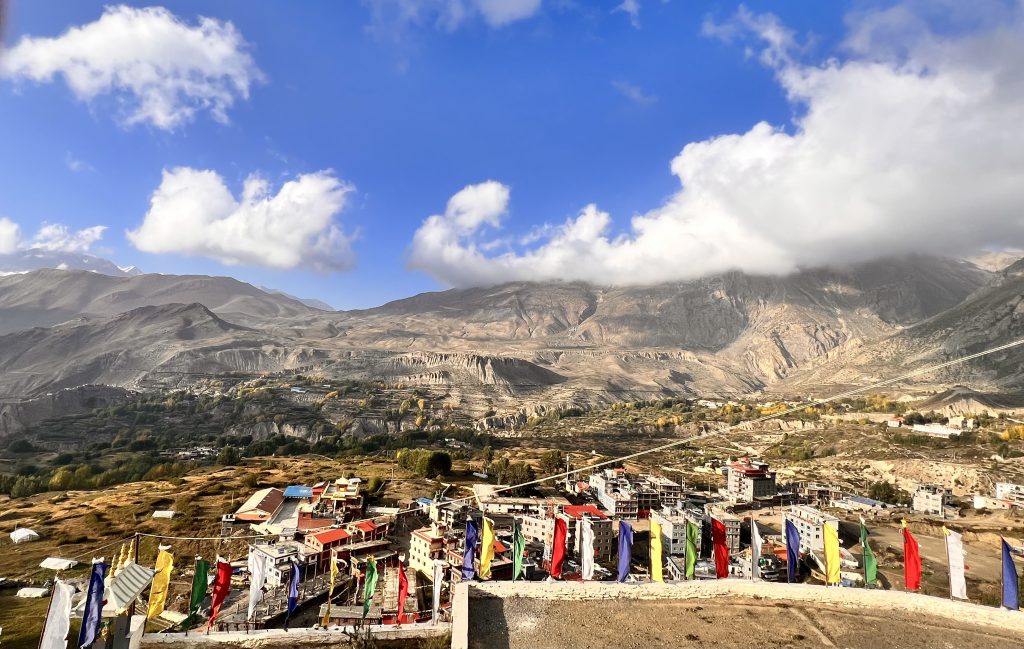
Mustang is the most popular trekking destination in Nepal. The trails of Mustang take you through a dramatic, treeless landscape, featuring rugged cliffs and breathtaking views of Annapurna, Mt. Dhaulagiri, Nilgiri, Tilicho Peak, Tukuche Peak, Mustang Himal, and Arniko Chuli. This stunning Himalayan valley lies in north-central Nepal, at the head of the Kaligandaki River, and is divided into two regions – Upper Mustang and Lower Mustang.
Upper Mustang trekking is a popular trekking way which offers striking mountain view including Annapurna I (8091m), Dhaulagiri (8167m) and significantly more. Upper Mustang trek will give you a chance to visit the primary city, Lo-Mangthang which in certainty is a requesting trek because of transcending elevation around 3800 meters, uncovered geology and repetitive solid breezes. The whole area is notable for its off the beaten path caverns, religious communities, chortans and sterile and fruitless circumstances. The people of the Upper Mustang is called as the Lobos, privately named as Lo. Upper Mustang is additionally eminent for having some of the fundamental Tibetan Buddhist cloisters of Nepal, which grasps surprising fine art.
Upper Mustang trek is furnished with rich experience of remoteness in the mystery universe of Buddhist occupants of Mustang. Regularly accepted to be a persona valley, trails for Upper Mustang was opened amid 1992. You will be enchanted by the magnificence of the scene, old cloisters, Stupas, Kannis,chortens, Mani Walls, Prayer Wheels, and will get the chance to become more acquainted with the occupants who seem to have been impacted by Tibetan culture as it were. Upper Mustang is otherwise called “Mountain Desert” and “Scaled down Tibet of Nepal”, which is likewise the motivation behind why such a significant number of individuals go for this trek. You will encounter the best cordiality in your trek to Lo Manthang; the disengaged circumstance of Manthang is truly fulfilling to understanding, you will trek through a fruitless scene, by means of the precarious trail, climbing and slipping a few times.
You will begin your trek after your drive to Pokhara from Kathmandu and after your trip to Jomsom. From Pokhara, you will fly the whole distance to Jomsom, which is a 30-minute flight. From Jomsom, you will trek to Kagbeni. Seeing the awesome perspective on mountains, you will take off to Chele from Kagbeni. Leaving Ekle Bhatti, passing the Taklam La Pass, you will touch base at Syangboche. Achieving the Yamada La Pass, passing Ghami, you will reach Tsarang. Following day, you will take off to Lo-Mangthang, which is arranged at the elevation of3880 m. At that point, you will reach to Dhi where townspeople appear to be occupied and worried about their own lives. Trekking back to Ghami can be very testing. By means of Samar (3,660 m), you will come back to Kagbeni. You will fly back to Jomsom from Kagbeni, and after that, make to Pokhara by means of air. In the wake of visiting some appealing lakes and spots at Pokhara, you will drive back to Kathmandu.
You will require an additional permit as you will be trekking in a restricted region. You must trek in a group of at least two with a government-licensed guide in addition to having a solo permit. Two kinds of permissions are required to participate in the Upper Mustang Trek.
ACAP (Annapurna Conservation Area Permit)
For foreigners, the cost of an ACAP (Annapurna Conservation Area Project Permit) is around NPR 3000; for SAARC citizens, it is NPR 1,000; and for Nepalese, it is NPR 100. Children less than ten can use it for free.
Valid for the duration of the trek, this pass allows for one admission. Further hikes like the Annapurna Circuit and the ABC trek require it as well.
The amount of time that can be spent in the Annapurna region is not limited. However, a Restricted Area Permit (RAP) is required for anybody entering Upper Mustang (starting from Kagbeni).
This special permission covers a number of local municipalities. This comprises Baragung Muktichetra Rural Municipality (ward no. 3 and Satang Village of ward no. 5), Lomanthang Rural Municipality (wards 1 to 5), and Lo-Gekar Damodarkunda Rural Municipality (wards 1 to 5).
For the first ten days of this special permission, each person must pay USD 500; after that, each person must pay USD 50 per day.
Food is a vital component of any journey, but on high-altitude experiences such as the Upper Mustang Trek, it becomes even more important. Food plays a major role in the Upper Mustang Trek Trek’s success and general enjoyment. In order to sustain their bodies and fulfill the physical demands of the challenging terrain and breathtaking beauty of the Himalayas, trekkers must maintain a well-balanced diet.
A remote trekking area in Nepal goes by the Upper Mustang Trek. Food must thus be carried over these treks by animals or porters. As such, some tea houses serve solely the staple dish of Nepal, “Dal Bhaat.” Though they are more expensive, you may discover certain tea houses that provide a variety of options on the menu.
The Upper Mustang trip has excellent food, a blend of traditional Nepali/Tibetan and Western foods. For breakfast, there are toast, eggs, oatmeal, and hot drinks like coffee and tea. You may also obtain different types of tea, such as butter tea, garlic tea, mint tea, and others.
For snacks throughout this hike, you can bring protein bars, chocolate bars, granola bars, dried fruits, and other items. There are tea houses and lodgings that serve a variety of international cuisines.
During your trip, potato meals like roast potatoes and hash browns are quite popular. Although they are less popular on higher trails, other menu items including pizza, momo, and noodles are still available.
Dal Bhat is often served for lunch, and for supper, you can order from the teahouse menu, which typically includes items like fried rice, spaghetti, thukpa (soupy noodles), sandwiches, and momo (dumplings).
Accommodations are more easily accessible than on prior treks in the area. As a result, it is becoming increasingly well-known. A greater number of tea houses, lodges, and homestays emerged in the area as a result of the massive inflow of trekkers.
The majority of the hotels and guesthouses in the Upper Mustang region provide tourists with lodging that includes a western toilet and other standard amenities. Due to the remote location, high cost of transportation, and low population density, accommodations in Upper Mustang are rather pricey.
Up until you reach higher elevations, when the accommodations are more basic with only the basics, you may discover more comfortable and higher-quality teahouses with adjacent bathrooms.
The Upper Mustang trek is the only tea house journey in Nepal that you can undertake without having to deal with the summertime monsoon rains. Expect nothing like the luxury of the Everest Base Camp Trek. Even now, hardly many people visit the area, and the lodging is still quite modest yet authentic. You will thus have the opportunity to sample regional cuisines, such as yak cheese and yak butter tea, even if WiFi and hot water might not be accessible.
The city of Kathmandu is where your journey to Nepal begins. There are many places to stay, from five-star deluxe hotels to reasonably priced motels. These accommodations provide a wide range of cuisines at different price points. They serve a wide range of Western and international cuisine.
Accommodation in Teahouse
On the mountain routes, a teahouse is comparable to a basic guest house. In addition to lodging and food, it offers a social hub for hikers. Many tiny tea houses owned and operated by local families may be found throughout the trip.
These are rustic, traditional tea houses that provide minimal amenities including accommodation, meals, and hot showers. You may engage with the people, sample traditional cuisine, and get a flavor of their way of life by staying at these tea houses, which provide a unique experience.
It’s well known that tea houses offer the best lodging options for trekkers doing the Upper Mustang Trek. Simple types of tea houses are accessible, aided by wealthy residents with extensive local knowledge.
Lower altitude tea houses can include fully equipped rooms with wifi, power, Western-style toilets, and, most importantly, hot showers. On the other hand, some tea rooms—especially those at higher altitudes—offer very limited amenities.
The teahouse is another great place to meet locals looking for adventure adventures. While some teahouses on less-travelled paths like Upper Mustang Trek have solar or electric heaters, others only have buckets of hot water.
Though you will have separate beds, you may have to share a room with other hikers. Moreover, restrooms are typically shared. Because Tibetan culture and customs have impacted Upper Mustang, everyone gathers in the kitchen, which resembles a living room, to engage in conversation.
Upper Mustang Trek Difficulty
Altitude trekking is never truly easy. During the initial days of trekking, there will be some gasping and puffing as it takes some time to acclimate. An intermediate hiker with a reasonable degree of physical fitness is advised to take the Upper Mustang Trek.
There are ups and downs to test you, just as on any journey in the Nepal Himalayas. There are severe descents to navigate and high mountains to cross. At 2800 meters, the Upper Mustang journey begins rather high; nonetheless, the height climb is somewhat moderate.
There are certain days that are very long—up to 22 kilometres. While walking, the combination of high altitude, dry air, and strong winds can be quite uncomfortable. The area has a high-altitude landscape and lengthy paths. This hike has some challenging terrain because it passes above 3500 meters. Trekkers must therefore possess the necessary strength, endurance, and stamina to successfully finish the walk.
Altitude sickness is one of the trickier and more challenging aspects. Higher heights are typically associated with decreased oxygen concentrations, which is why acute mountain sickness is predicted. Diarrhea, nausea, vomiting, headaches, sleeplessness, fever, dizziness, and shortness of breath can all result from this.
On these trips, managing altitude sickness necessitates regular water, acclimatization, a healthy diet, and enough sleep. Trekkers need to get down to a lower altitude right once if they show significant symptoms of altitude sickness.
Trekking the Upper Mustang requires you to carry a modest, 5-7 kilogram backpack and hike for up to 5 hours per day at a maximum height of 3840 meters. You must train by going on lengthy treks and/or participating in your preferred sport, such as running.
A moderate level of fitness is recommended for the Upper Mustang Trek. Before contemplating the trek, anyone with pre-existing medical conditions should see a doctor. Before being completely acclimated, it is normal to feel a little uncomfortable while on the trek.
Along with these paths, these cardiovascular or aerobic workouts will improve your breathing and flexibility. You will benefit from these exercises in high-altitude situations with little oxygen and air pressure. These workouts include push-ups, pull-ups, squats, and others.
People of various ages with strong endurance, fitness, and agility can make it to the Upper Mustangs. Developing stronger legs will make managing the ups and downs simpler. Add exercises like step-ups, lunges, and squats to your repertoire.
The best times of year for trekking in Mustang are in the spring and fall. The weather in the area is lovely and consistent during these seasons. When choosing whether or not to trek to Upper Mustang, the weather is the deciding factor.
When fresh plants grow and flowers blossom in the spring, everything in Mustang comes to life. As you go toward the Mustang, the breathtaking beauty of nature will envelop you. The region is covered in verdant vegetation and blooms in the spring, such as junipers and rhododendrons.
As you walk these routes, you’ll be accompanied by the perfume of fragrant therapeutic plants and flowers. The weather is pleasant throughout this season, with daily highs of 16 to 22 °C. The nights, however, are cooler since the mercury might drop below zero degrees. It’s dry season in the Upper Mustang during Nepal’s monsoon, so you don’t have to worry about treacherous paths and leeches.
The dry part of Upper Mustang is situated in the rain shadow zone. Almost no precipitation falls during the year. In the nation, the monsoon season lasts from June to September. The Upper Mustang’s rivers and animals are at their most plentiful in the summer.
In Lower Mustang, wet weather can occur during the summer or monsoon, which might make the first few days’ paths muddy and dangerous. The people of Upper Mustang hold horse festivities on a full moon day in August. Summertime temperatures vary from 16 to 25°C. The temperature at night is between -3 and 0°C.
In Nepal, autumn is the busiest and most popular season for trekking to the Mustang. In the fall, bookings may need to be made well in advance. Amazing vistas of hills, mountains, and other picturesque settings await every tourist. In addition to having bright, beautiful skies and comfortable temperatures, autumn is the ideal season for midday hiking.
Mustang usually has dry, cold weather with better skies in the fall. In Hindu tradition, the fall season is sometimes referred to as the “season of festivals,” and it encompasses several celebrations including Dashain and Tihar.
The temperature ranges from 12 to 20°C during the day and drops to -8 to -4°C at night. Additionally, be aware that the residents of this area are seasonal migrants who relocate to lower elevations during the bitterly cold winter months. As a result, you could encounter issues finding lodging throughout November.
Mustang experiences some of the coldest winters due to an abundance of snowfall. For your safety, a few of the high passes and short peak climbs could stay closed. By November, the trekking season ends. The lodges are closed since the locals are moving to other areas to escape the cold. Furthermore, the pathways are covered with snow, making hiking nearly difficult. Winter trekking in the Upper Mustang is possible, but it’s really chilly, so make sure you pack appropriately.
You may be familiar with the phrase “accommodation day” from walking in Nepal at heights higher than 2,500 meters. Simply defined, acclimatization is giving your body adequate time to adjust to the changes brought on by the higher altitude. The air density drops with elevation, lowering the amount of oxygen molecules in each breath.
In order to properly acclimate and prevent altitude sickness, this journey includes a day of rest at Lo Manthang. During acclimatization, your body will have enough rest to produce more red blood cells, which are essential for increasing the amount of oxygen that reaches your muscles and organs. By doing this, the body can acclimate to lower oxygen levels and prevent altitude sickness.
During the acclimatization period, you will have plenty of opportunities to stroll around villages and do short treks up the small hills. You can enjoy the beauty and the vista of the mountains without having to worry about getting altitude sickness.
You will get the opportunity to visit Namgyal Gompa, a prominent hilltop monastery in the region, during your acclimatization period. Locals utilize Namgyal Gompa as a major monastery as well as a court.
Equipment And Packing List:
Important Documents and Items:
Clothing Essentials for the Upper Mustang Trek:
Head:
Upper Body:
Hands:
Lower Body:
Feet:
Sleeping Gear:
Medical Kit:
Toiletries:
Personal Hygiene:

Write Your Review